
Group and Individual Instruction
in Math & Other Subjects
by Zoom or in Person
More information for:
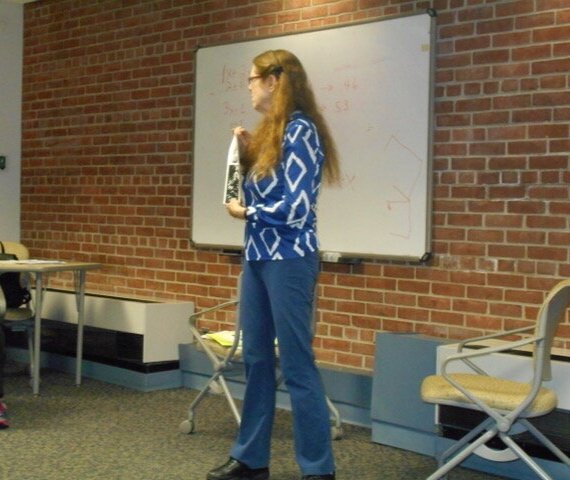
My name is Barbara Bernstein and I hold a Ph.D. in Education and a Master’s Degree in Mathematics Education from the University of Maryland. I've also published articles on teaching methods and educational psychology as well as an imaginative children’s storybook with a mathematical theme!
I teach things “from the ground up,” explaining all terminology to help students grasp the foundational concepts. I avoid having students don’t memorize rules or formulas until they are as clear as possible on the underlying ideas.
I am able to teach school classes as well as tutor individuals—in person or remotely. My zoom classes are conducted with a document camera which enables me to write things out so they look the same as they would on a blackboard or whiteboard. I'm very flexible and happy to construct a unique program of instruction to suit individual needs. This can include after-school or summer school programs, etc.
My mission is to cut through convention to achieve learning in ways that are comfortable for students. Among other things, this involves recognizing that students’ mistakes are their best learning tool. We examine mistakes to see how a student is thinking and where they need help. It also means frequently including review questions rather than covering only one topic in a lesson. Retention and understanding are both vastly improved when teachers move back and forth between different topics, giving the material time to “sink in.”
Ever heard a student say that they understood a math problem and did all the steps correctly, but they just made a calculation error? The implication is that the error "wasn’t important" since they do know the material. However the concept of a student understanding something perfectly well, and simply making an arithmetic mistake is misleading. This can indeed happen. But the fact is that when someone knows a mathematical process very well, they are less likely to make such mistakes….
Here’s why: When students are thinking about what step comes next, their attention is focused on that. So they aren't as focused on the arithmetic. This makes mistakes more likely. (Think of how much more likely you are to make a mistake when you are distracted, for example.) So calculation errors are sometimes a sign that the student may not be that solid on the material. It’s best not to dismiss these errors, and instead to recognize that arithmetic mistakes might be telling you something!
These and other insights guide my instruction as I work to help students grasp math concepts so they can comfortably think through how to solve math problems. I primarily teach students in grades 5 to 12, or adults, who are taking classes below the level of Trigonometry.
*************************************************************************************************
Note that this website has many FREE instructional videos. They cover adding, subtracting, multiplying, and dividing with fractions, percents, and decimals, as well as exponents and solving equations in one and two unknowns. These videos were put online to help students at no charge. Please feel free to share them with friends.
I teach primarily in Mathematics, but often help with other subjects too.
You are welcome to contact me any time, and describe what kind of help you need.
WORDS OF WISDOM:
“I've missed more than 9,000 shots in my career.
I’ve lost almost 300 games.
Twenty-six times, I’ve been trusted to take the game winning shot and missed.
I’ve failed over and over again in my life.
And that is why I succeed.”
—Michael Jordan